English (UK)
  Italian (IT)
  French (FR)
  Japanese (JA)
  German (DE)
  Russian (RU)
  Spagnolo (ES)
  Português (pt-PT)
  Nederlands (nl-NL)
  Danish (DA)
  Czech (CZ)
  Polacco (PL)
  Turkish (TR)
  Korean (KR)
  Magyar
  Українська (Україна)
  简体中文(中国)
 IMAT - INTERNATIONAL MEDICAL ADMISSIONS TEST PREPARATION COURSE

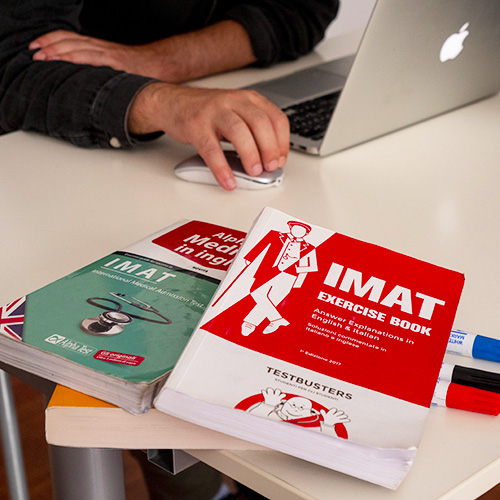
Study Medicine in Italy in English - IMAT preparation course for the entrance exam (online or on-site)
Italian Universities of Bari, Milan, Pavia, Rome La Sapienza, Rome Tor Vergata, Seconda Università of Naples, Turin, Padua, Bologna... are now offering undergraduate Medicine and Surgery courses taught in English.
In order to access these academic programs, applicants must pass IMAT, the International Medical Admissions Test, and the official Entry test developed by the Italian Ministry of Higher Education and Research (MIUR).
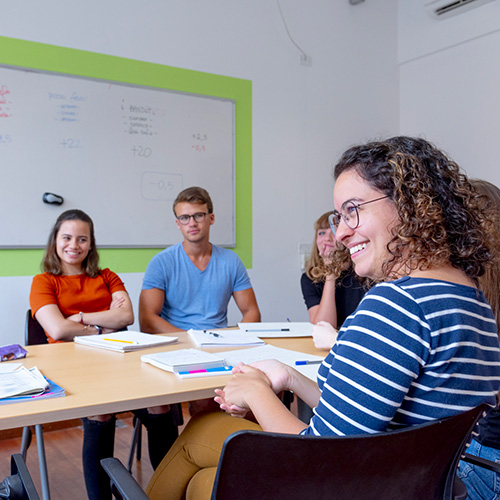
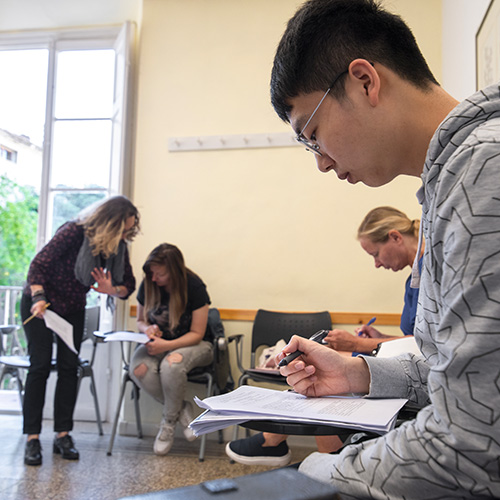
Scuola Leonardo da Vinci organizes a specific University Preparation Corse for IMAT in Florence, Milan, and Rome, aiming to provide a scientific and logical critical skills basis to all foreign students willing to attempt IMAT in order to enter an Italian Medicine Faculty.
The course can be online or on-site and it's in English.


Discover everything you need to know about the IMAT test in Italy, including our preparation course dates and prices, by visiting our dedicated website: https://www.university-in-italy.com/educational-offer/prepare-for-imat/
You can find all the information about studying at University in Italy, including Medicine preparation courses, TOLC-F and TOLC-MED preparation classes.
This section will assess the thinking skills that students must possess if they are to success in a course of study at the highest level. The Imat Preparation Course aims, therefore, to let the student practice with a series of questions focusing on how to solve novel problems, consider arguments put forward to justify a conclusion or to promote or defend a particular point of view.
In particular, the Critical Thinking deals with summarising and drawing conclusions, identifying assumptions, assessing the impact of additional evidence, and detecting reasoning errors. This area of study involves reasoning using everyday written language.
As for the Problem-Solving area, students will practice with questions related to numerical and spatial skills. Exercise will be of three kinds: relevant selection, in which the task is to select only that information which is necessary for finding a solution, finding procedures, that is to say finding the method which you can use to generate a solution, and finally identifying similarity, where it is required to identify the same information presented in a different way.
The science-based section focuses on those questions covering Biol Chemistry, Physics, and Mathematics. Students will deal with theory and practice, as in section 1 by practicing on multiple-choice questions.
As for biology main areas will be: the chemistry of living things, the cell as the basis of life, bioenergetics, reproduction and inheritance, inheritance and environment, anatomy and physiology of animals and humans.
As for Chemistry: the constitution of matter, the structure of the atom, the periodic table of elements, the chemical bond, fundamentals of inorganic chemistry, chemical reactions and stoichiometry, solutions, oxidation and reduction, acids and bases, fundamentals of organic chemistry.
As for Physics: measures, kinematics, dynamics, fluid mechanics, thermodynamics, electrostatics, and electrodynamics. And finally for Mathematics: algebra and numerical sets, functions, geometry, probability, and statistics.